January 5, 2005
Using Assistive Technology to Maximize Communication Development: Gareth’s Story
by Janice Light, Brandy Prebble, and Travis Prebble
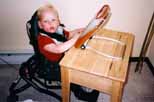 Gareth's Story appears in "Success Stories 2004: Consumer Perspectives," published by the National Center for Dissemination of Disability Research (NCDDR). The Fall 2005 issue of our eNewsletter contained "Tracy's Story," which also appears in this publication. To view the publication in its entirety, visit NCDDR's Success Stories 2004: Consumer Perspecitives.
Gareth
is 2 years old. Like many children his age, he loves to read books with
his mom or dad and play games like “Go Fish” or “Concentration”. Yet
Gareth faces significant challenges in his life.
His parents,
Brandy and Travis explained, “During birth, Gareth’s umbilical cord
prolapsed, depriving him of oxygen for quite some time. Due to this
trauma at birth, Gareth now has cerebral palsy. He has very low muscle
tone and is functioning at about a four month level in both his fine
and gross motor skills. Gareth had no gag reflex shortly after birth
and to this day cannot swallow consistently. Because of this, Gareth
has a tracheotomy. He cannot speak due to the trach, and his low muscle
tone inhibits his ability to use sign language. However, Gareth is not
delayed cognitively.”
“Early on, he started to show signs of
frustration because he could not communicate his wants and needs with
us. When Gareth was 22 months old, we took the initiative to start a
simple picture communication system with him, consisting mostly of
photographs of all of his toys so that he could choose with which toy
he wished to play. Gareth learned this system quickly and was happy to
at last have some small way to communicate. With the help of his speech
language pathologist, we introduced some simple voice output
communication aids to Gareth as well. He was able to use all of these
with ease, but it was clear that none of these devices provided Gareth
with enough opportunities to communicate. Nor did they allow him to
communicate on his own, without our intervention in providing his
initial selection of choices.”
When Gareth was 24 months old,
his speech language pathologist introduced him and his family to Janice
Light, a professor in the Department of Communication Sciences and
Disorders at Penn State University. Dr. Light is a principal
investigator on a research grant funded by the National Institute on
Disability and Rehabilitation Research (NIDRR) as part of the
Rehabilitation Research Engineering Center on Communication Enhancement
(the AAC-RERC). Dr. Light, along with her co-investigator Dr. Kathryn
Drager, head up a 5-year research study designed to improve the design
of augmentative and alternative communication (AAC) assistive
technologies for young children to maximize language learning and
functional communication.
In the past, young children like
Gareth often found it difficult to learn to use AAC assistive
technologies. Current AAC technologies were all developed by adults and
their designs tend to reflect adult ways of thinking. The
representations of language concepts used in these technologies and the
organization and layout of these concepts on the computer screen are
not developmentally appropriate for young children. As a result, it is
difficult for very young children to understand and learn to use
traditional AAC technologies. Through the NIDDR-funded research
project, Janice Light, Kathy Drager, and colleagues have investigated
new ways to design AAC technologies to reduce their learning demands
and increase their appeal for young children like Gareth. With improved
“child-friendly” designs for AAC technologies, it has been possible to
intervene with children at much earlier ages to maximize their language
development and communication.
As participants in the research
grant, Gareth and his parents worked with the research team in weekly
sessions at their home to develop appropriate AAC assistive technology
to meet Gareth’s needs, to implement these systems within his daily
life, and to evaluate the impact on Gareth’s language and communication
development.
Gareth made rapid progress learning to use his
new AAC assistive technology. When Gareth first started in the research
project at 25 months of age, he had approximately 50 pictures that he
used to communicate, mostly to request favorite toys. He typically took
approximately one turn in 5 minutes of interaction. After 12 weeks of
intervention through the study (at 28 months of age), Gareth had
acquired more than 400 words /concepts. He learned to express a wide
range of language concepts including people, actions, objects, places,
social words, descriptors, questions, and relational concepts. In fact,
he learned approximately 4-5 new concepts a day, keeping pace with
rates of typical language acquisition. He began to combine concepts
into 2 and 3 word sentences to communicate more complex ideas. He was
much more active and engaged, taking more than 10 times the number of
turns that he used to take in interactions with others. At last count
(at 30 months of age), Gareth had over 700 words and concepts.
His
parents described Gareth’s progress: “The use of AAC technology was a
natural fit as Gareth has inherited his father’s love of computers. His
enthusiasm was evident every time Janice brought the system during her
visits. At first, the system was programmed with a few of Gareth’s
favorite songs and books. Gareth thoroughly enjoyed his new ability to
sing and read through the system, and we delighted in listening to him!
More concepts and choices were then added to Gareth’s system, including
menus and levels of options to accommodate his growing vocabulary.
Gareth quickly learned how to navigate through the menus so that he
could find the ideas he wished to convey. Using strings of images, he
was able to start creating two and three word sentences, such as “Bus
go fast” in describing how he wished us to manipulate his toy bus.
Gareth now uses his AAC system to communicate to a variety of people.
He can finally talk with other children, can sing in groups, and can
use his system to engage in imaginative play. Others around Gareth are
now starting to realize his strengths and abilities and are interacting
with him more frequently and for longer periods. As his parents, we are
thrilled to hear our son and to watch him show off his new found
abilities! Now Gareth truly has his own voice.”
Acknowledgement:
This research is part of the Rehabilitation Engineering Research Center
on Communication Enhancement (the AAC-RERC), a collaborative virtual
research center, funded by the National Institute on Disability and
Rehabilitation Research (NIDRR) through grant H133E030018. The opinions
expressed are those of the grantees and do not necessarily reflect
those of the granting agency. For further information about this grant,
email Janice Light at JCL4@psu.edu
|
|
|